Written by
Vicky Hawes
Published on
June 5, 2026
.png)
In one of Australia’s most important care sectors, preparedness matters long before an alarm sounds.
Australia’s residential aged care sector supports some of our most vulnerable community members.
Behind every number is a person: someone’s parent, sibling, grandparent, partner or friend. Many live with reduced mobility, cognitive decline, chronic illness or complex care needs. And all rely on staff not only for daily support, but for their safety when something unexpected happens.
The scale of that responsibility is significant: at 30 June 2025, 196,313 people were living in permanent residential aged care across Australia, with almost one third living in New South Wales, followed by just over 50,000 residents in Victoria and just shy of 40,000 in Queensland. There were 236,894 operational residential and flexible places, managed by 707 approved providers, many operating multiple facilities across different regions and states. The sector also represents a sizeable part of the economy, with Australian Government expenditure on residential aged care estimated at A$24 billion in FY24/25, according to the Australian Government’s report, 2024-25 Report on the Operation of the Aged Care Act 1997.
As demand grows and expectations rise, one responsibility sits at the heart of quality care: being ready when it matters most.
Emergency planning obligations can arise under workplace health and safety legislation, building requirements and other regulatory frameworks. In practice, many organisations look to recognised Australian Standards to guide how those plans are developed and maintained.
AS 3745-2010 Planning for Emergencies in Facilities is the principal Australian Standard used to support emergency planning across a wide range of facilities. It is referenced in workplace guidance materials and provides a structured approach to preparing for emergencies before they occur.
The standard sets out requirements and guidance relating to:
For healthcare and care environments, AS 4083-2010 Planning for Emergencies – Health Care Facilities may also be relevant, as it addresses issues such as continuing care during emergencies, varying resident dependency levels and the operational realities of patient or resident settings.
For residential aged care providers, the key takeaway is simple: emergency plans should not only exist – they should be practical, current and aligned to the specific needs of the people and buildings in your care.
“Aged care emergency planning should challenge fire protection service providers and facility managers to think beyond the building and start with the residents. For people living with dementia or complex care needs, how staff and responders communicate before and during an emergency can be just as important as the evacuation pathway itself. For example, practical dementia-awareness training, such as the free Dementia Australia’s professional development resources and Dementia Training Australia’s first responder course, should be part of any serious plan.” – John Collie, Former Chief Executive Officer, Fire Protection Association Australia.
.png)
Emergency planning in residential aged care is rarely straightforward.
Unlike many workplaces, occupants may not be able to self-evacuate quickly or independently. Some residents may require physical assistance. Others may become distressed, confused or disoriented during alarms. Some may depend on mobility aids, oxygen, medication or clinical support.
That means emergency response is not only about moving people. It’s about moving the right people safely, calmly and with dignity.
It may also involve difficult decisions in real time, including moving residents horizontally or externally, managing after-hours staffing constraints, communicating with families and coordinating with emergency services.
For leaders in residential aged care, preparedness is both an operational responsibility and a very human one.
What real incidents have taught us
One example often cited by the sector is the Quakers Hill nursing home fire in 2011, which remains one of Australia’s most significant aged care fire tragedies. Subsequent reviews highlighted the complexity of evacuating frail residents, the importance of staff training, early escalation, clear communication and systems designed for real conditions.
“Regular training and evacuation drills should be undertaken by all staff, including practising urgent removal of non-ambulant residents.”
Fire and Rescue NSW 2
In February 2026, over 30 residents at an aged care home in Melbourne were evacuated at night and relocated to two other aged care facilities following a roof fire, with reports that some residents were distressed during the evacuation and others required medical treatment for smoke inhalation.
Two very different incidents more than a decade apart, with one clear lesson: preparedness must begin before the emergency.
“Having served as an operational firefighter for more than 40 years—including many years as a fire commander—I have worked extensively with the residential aged care sector in emergency planning, evacuation exercises, post-incident response, and Australian Standards relating to fire safety and emergency preparedness. One question must always be asked:
If a serious emergency occurred tonight, would the system genuinely protect the people entrusted to its care, or merely demonstrate that paperwork existed and boxes had been ticked?’
Using the ARCC of FIRE accountability model:
I have also worked with the Locatrix organisation over many years and have seen first-hand its commitment to accountability, preparedness, and the safety of residents within the aged care sector.”
Graeme Thom AFSM, Fire Commander (Retd)

Across the sector, expectations around safety, governance and emergency readiness are increasing.
Recent reforms including the Aged Care Act 2024 and strengthened Quality Standards have sharpened focus on risk management, documented planning, continuous improvement and protecting older people from harm.
At the same time, broader fire safety reforms across Australia are increasing attention on testing, documentation, maintenance and system integrity.
The message for providers is clear: emergency preparedness is no longer a peripheral issue. It is part of responsible care delivery.
In residential aged care, responsibility for fire safety and emergency readiness may be shared across a number of roles depending on the size and complexity of the provider:
While responsibilities differ, the goal is the same: protecting residents, supporting staff and ensuring every site is ready when an emergency occurs – as well as answering any questions first responders may have when they arrive at the scene.
For many providers, the challenge isn’t understanding what needs to be done. It’s coordinating people, systems and evidence consistently across the organisation.
Strong providers are moving beyond static binders and fragmented manual processes. They are building systems that help them maintain confidence across every site.
That often includes:
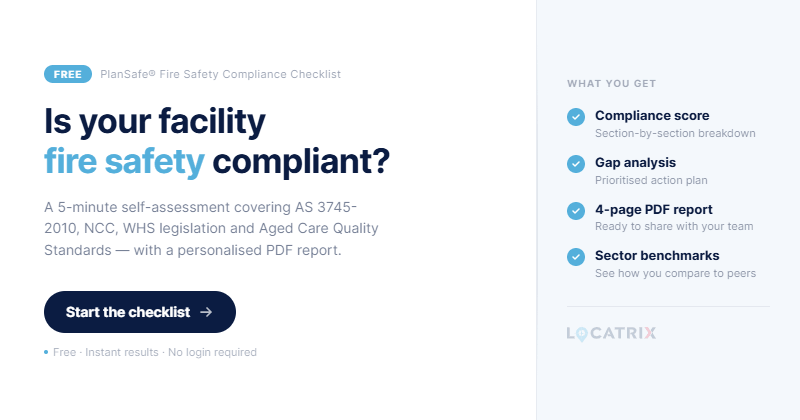
A quick self-check:
If any of these questions create uncertainty, it may be time for a closer review.
Residential aged care is built on trust. Families trust providers to care for the people who matter most to them – every day, and especially in the moments they cannot predict.
That’s why emergency readiness matters: not as a once-a-year exercise, but as an ongoing commitment to safety, dignity and confidence.
Locatrix works with leading aged care providers to support practical emergency readiness – from site-specific online training and compliant evacuation diagram tools that help keep information current and accessible.
Explore how PlanSafe can support your aged care emergency compliance, or complete the Locatrix Compliance Checklist and download your results to take action.
.jpg)