Written by
Vicky Hawes
Published on
February 2, 2026
.png)
.png)
In January 2026 we caught up with Aaron – also a former full-time firefighter with over 20 years’ operational experience – to understand what the reforms are really aiming to achieve, and what organisations should be paying attention to now.
“The standards themselves aren’t new. What’s changing is that they’re now being enforced consistently, and practitioners are being asked to genuinely stand behind what they sign off,” says Aaron.
Australian Standard AS 1851–2012 has existed for years, but Aaron believes inconsistent adherence, combined with incidents uncovered through investigations, has pushed the NSW Government to act.
“In sectors like health and aged care, audits can happen at any time. In other areas, compliance hasn’t always been as closely examined. These reforms are about lifting fire safety standards in all sectors,” says Aaron.
The result is a stronger focus on evidence: not just plans on paper, but proof that fire safety systems – including all measures featured in your Annual Fire Safety Statements – and being tested and maintained in accordance with Australian Standards.
From February 2026, Annual Fire Safety Statements will need to be signed off by accredited practitioners who are expected to verify that fire safety measures are being maintained as designed.
Aaron also notes that many organisations will be reviewed retrospectively, with assessors looking at what has been done over the past six to twelve months (not just what’s completed immediately before sign-off).
In the workplace emergency management area, Aaron is clear that generic plans and generic training don’t meet the standard:
“An emergency management plan is expected to include key features of the built environment, many of which are documented in the Fire Engineering Reports. Plans need to accurately reflect how a building has been designed, its occupancy and use, and how it will react in fire or emergency conditions.”
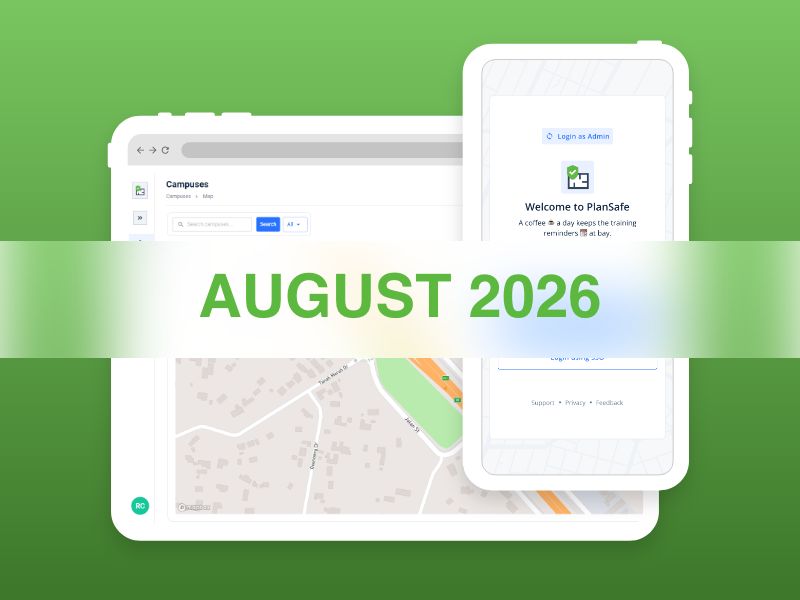
PRM’s approach combines practical exercises with site-specific, contextualised learning – which is where tools like PlanSafe and PlanStudio come in.
“PlanSafe allows us to deliver the theoretical training in a way that’s specific to the building – using the actual floor plans, even our own site-recorded videos. That makes a huge difference for understanding and retention,” says Aaron.
Importantly, this approach also reduces operational disruption, a major concern in hospitals, aged care and other complex environments.
“The biggest cost isn’t the training provider; it’s pulling people off the floor. Online, contextual training lets us be far more efficient while still meeting the standard,” says Aaron.
Aaron also highlights an often-overlooked point of truth: Fire Engineering Reports (FERs) and other building design documentation.
“Depending on the occupancy profile of a facility, there is likely to be all manner of automated systems that either actively or passively prevent smoke travel, provide safe refuge, allow rapid evacuation for groups of varying size, suppress fires, operate building management systems, and so on. Our planning activities, such as developing the Emergency Management Plan and inducting or training our staff, may be a performance measure on an AFSS. This is where we will see greater scrutiny on the quality of that work, and how this work is being maintained into the years ahead,” says Aaron.
Under the new reforms, any disconnect between design intent, documentation and day-to-day practice is more likely to be identified – either through assessment or following an incident.
His guidance is simple:
“Work with people you trust. People who understand the standards, who’ve been in the industry, and who can show how compliance is being maintained – not just described,” says Aaron.
With clearer accountability and higher scrutiny, evidence-based preparedness is no longer optional.
PRM Training is part of the Form1 Group and has partnered with Locatrix for over 10 years, supporting organisations across healthcare, aged care, education, government and complex facilities to prepare people to respond confidently in emergencies.